

WHITE PAPER: Benchpeg investigates the definition of our Sector
Reading Time:
1 min {{readingTime}} mins
Benchpeg today launches its first White Papers - 'Defining the Invisible Sector' - A Comprehensive Definition of the UK Jewellery, Silverware, Horology & Allied Crafts Sector and 'The Invisible Sector' - Quantifying the True Economic Contribution of UK Jewellery, Silverware, Horology & Allied Crafts.
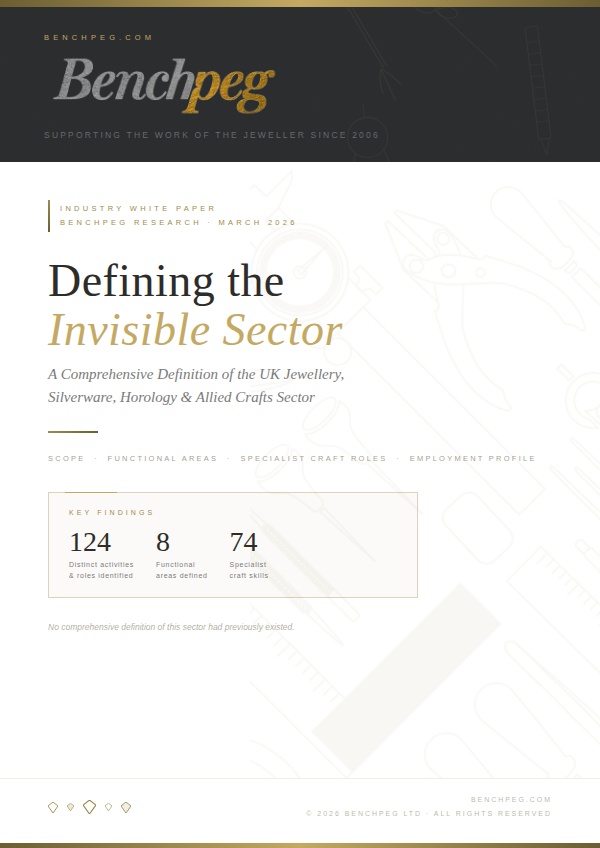
This report - 'Defining the Invisible Sector' - A Comprehensive Definition of the UK Jewellery, Silverware, Horology & Allied Crafts Sector aims to provide the scope, functional areas of the sector and defines specialist craft roles as well as providing an employment profile.
The key findings of the report are that this definition identifies 124 distinct activities and roles across 8 functional areas, of which 74 are specialist skills. No such comprehensive definition of this sector had previously existed.
The Executive Summary
The UK jewellery, silverware, horology, and allied crafts sector is one of Britain’s oldest continuous industries, with roots stretching back centuries through the Goldsmiths’ Company, the Worshipful Company of Clockmakers, and the hallmarking traditions enshrined in statute since 1300. Yet despite this heritage, and despite the sector’s substantial contribution to the modern UK economy, no comprehensive definition of what the sector actually comprises has ever been produced.
This absence has had measurable consequences. Government statistics rely on a single SIC code — 32.12 (Manufacture of jewellery and related articles) — as a proxy for the entire sector. Under this classification, the Department for Culture, Media and Sport (DCMS) values the UK Crafts sector at just £0.4 billion, employing an estimated 10,000 people. A companion white paper, The
Invisible Sector, maps the sector across 65 SIC codes and estimates its true economic contribution at £7.05 billion — over 17 times larger.
The definition set out in this paper was developed to address that gap. It was created as the evidential foundation for a submission to the ONS SIC 2026 revision process. It is the first attempt to describe the full ecology and supply chain of the sector in a single, structured framework.
This standalone white paper presents that definition in full, with each functional area’s constituent activities listed individually and alphabetically. Activities that represent specialist practised skills are marked with an asterisk (*). The paper also draws together available employment and business data to illustrate the scale of the workforce these activities support.
To read the report in full go here
Author:
Published: